Tom Pearman was commissioned to design and fabricate a pair of bespoke display cabinets for the pathology department at Castle Hill Hospital, Hull.
The cabinets were created to house and present a collection of historic scientific and medical instruments, including early X-ray tubes and laboratory equipment.
Rather than treating the cabinets simply as functional cases, Tom developed them as artworks in their own right, combining display, furniture design, lighting and fired-enamel imagery.
Medical science and the invisible figure
The imagery applied to the glass draws on the visual world of laboratories, scientific experimentation and what Tom describes as a sense of “mad science”.
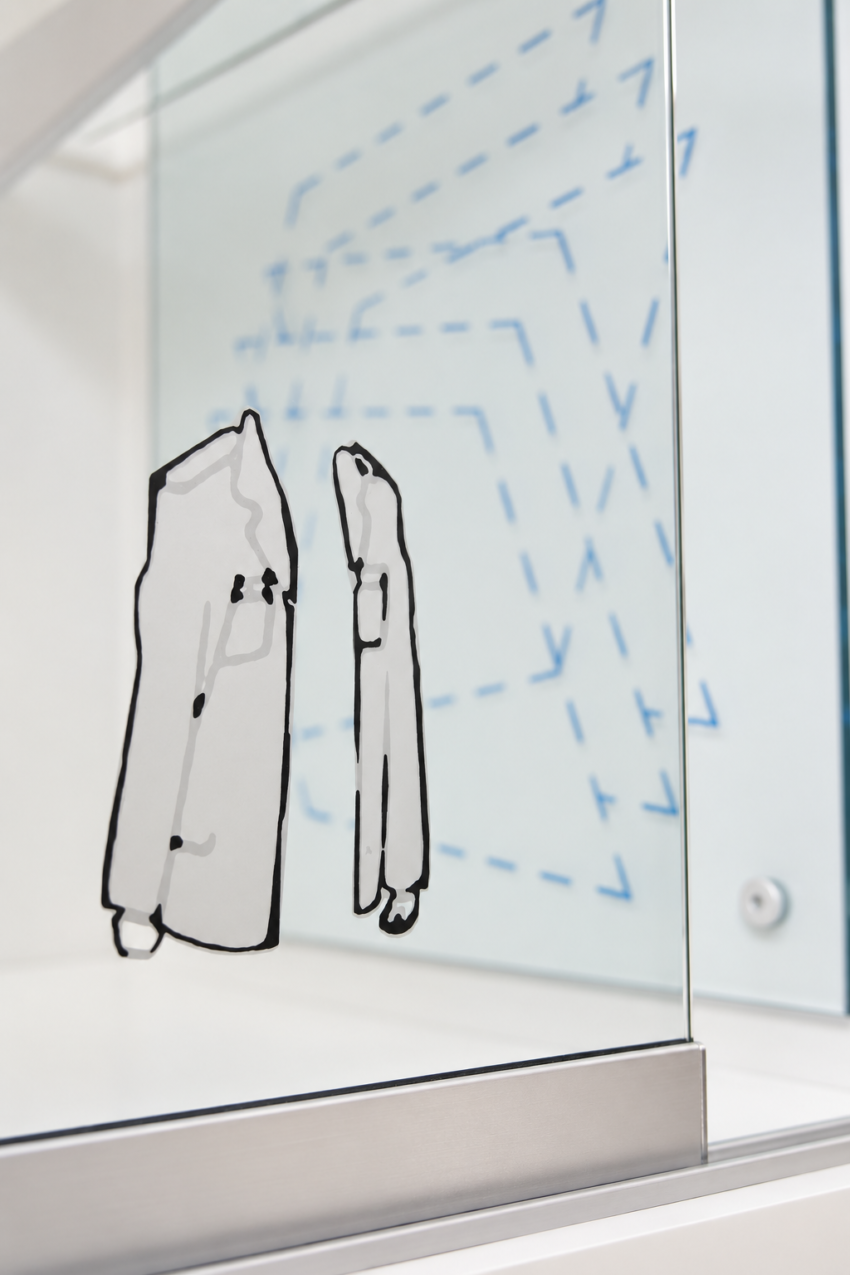
Fragments of laboratory clothing appear across the transparent surfaces, including coats, sleeves and partial figures.
Some of these images reference H. G. Wells’ The Invisible Man, where clothing becomes a way of suggesting a human presence that cannot otherwise be seen.
Within the empty or partially filled cabinet, these fragmented figures create an additional ambiguity: the objects on display appear alongside traces of the people who might once have used them.
Sound, frequency and scientific instruments
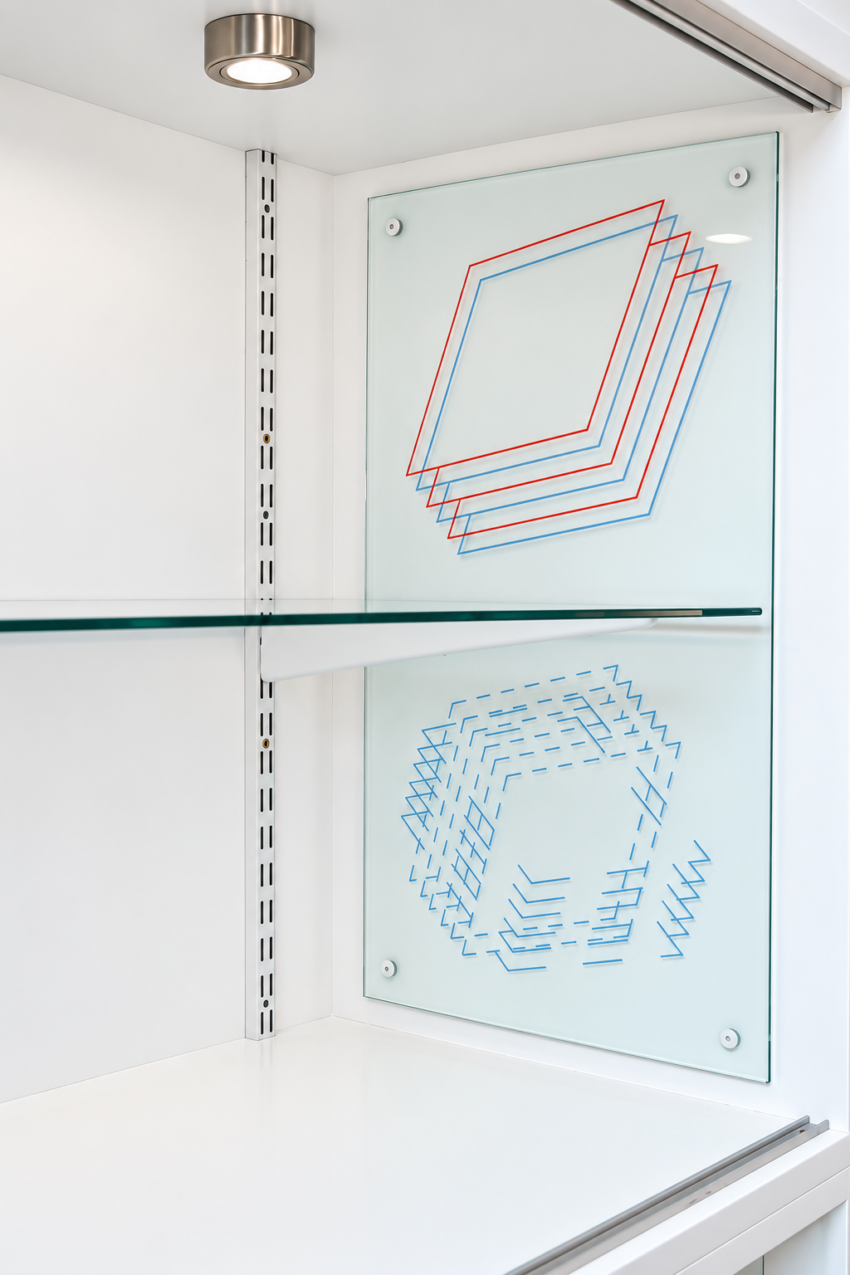
A second group of images consists of repeated geometric line forms.
These abstract patterns suggest waves, vibration, frequency or signals that might be generated by the scientific instruments displayed within the cases.
The forms do not illustrate a specific scientific process. Instead, they introduce a more speculative visual language that connects the historic equipment with ideas of measurement, transmission and invisible phenomena.
Glass and display
The imagery was produced in fired enamel on toughened safety glass, allowing it to become a permanent part of the cabinets rather than an applied surface decoration.
Because the graphics are printed onto transparent glass, they visually overlap with the instruments, shelves and architecture beyond.
This layering allows the cabinets to change according to what is displayed inside them and from where they are viewed.
Cabinet design
Tom designed the cabinets as complete objects, incorporating the sprayed MDF structure, glass shelving, oak base and integrated lighting system.
The restrained white finish was intended to give the historic instruments visual prominence while allowing the enamel graphics to remain subtle within the overall display.
The commission developed from Tom’s earlier experiments with bespoke display furniture, including a previous cabinet incorporating a custom laminated surface.
Art and collection
The project brings together two different forms of display: the historic scientific collection and a contemporary artwork responding to that collection.
Rather than creating a conventional museum case, the cabinet itself becomes part of the interpretation, introducing imagery concerned with science, invisibility, experimentation and the people behind the instruments.