Tom Pearman was selected as artist and consultant for the Capital Build Programme at Burnham-on-Crouch Primary School, developing a series of artworks integrated into the redesign of the school.
A major element of the commission was an architectural glass artwork for the main glazing of the new assembly hall. The project developed from Tom’s continuing interest in architecture, perception and the ways in which we understand and represent the built environment.
Sliding Puzzle
The East elevation takes the structure of a traditional sliding puzzle as its starting point. The glass is divided into a grid of individual sections containing fragments of an architectural image, creating the impression that the composition could be rearranged.
The imagery references the familiar Wile E. Coyote and Road Runner cartoon device in which a painted tunnel is mistaken for a real opening. Perception and architecture
The work asks a series of simple questions: How do we perceive the architecture around us? How can a three-dimensional environment be represented on a flat surface? And what visual devices allow a shape or opening to appear to have volume, depth and perspective?
Rather than providing a single visual answer, the artwork was conceived as a playful puzzle, particularly appropriate within an educational environment, where asking questions can be as important as finding answers.
Education and participation
The project formed part of Tom’s wider role within the school redevelopment, using art and architecture as a starting point for exploring perception, spatial awareness and visual problem-solving.
The sliding-puzzle structure provided an accessible way of introducing ideas about perspective, illusion and the representation of space, while the cartoon reference connected these architectural ideas with imagery familiar to younger audiences.
Related artwork
A second architectural glass artwork was developed for the South elevation of the assembly hall. Although part of the same commission, it adopts a distinctly different visual language and is presented as a separate project.
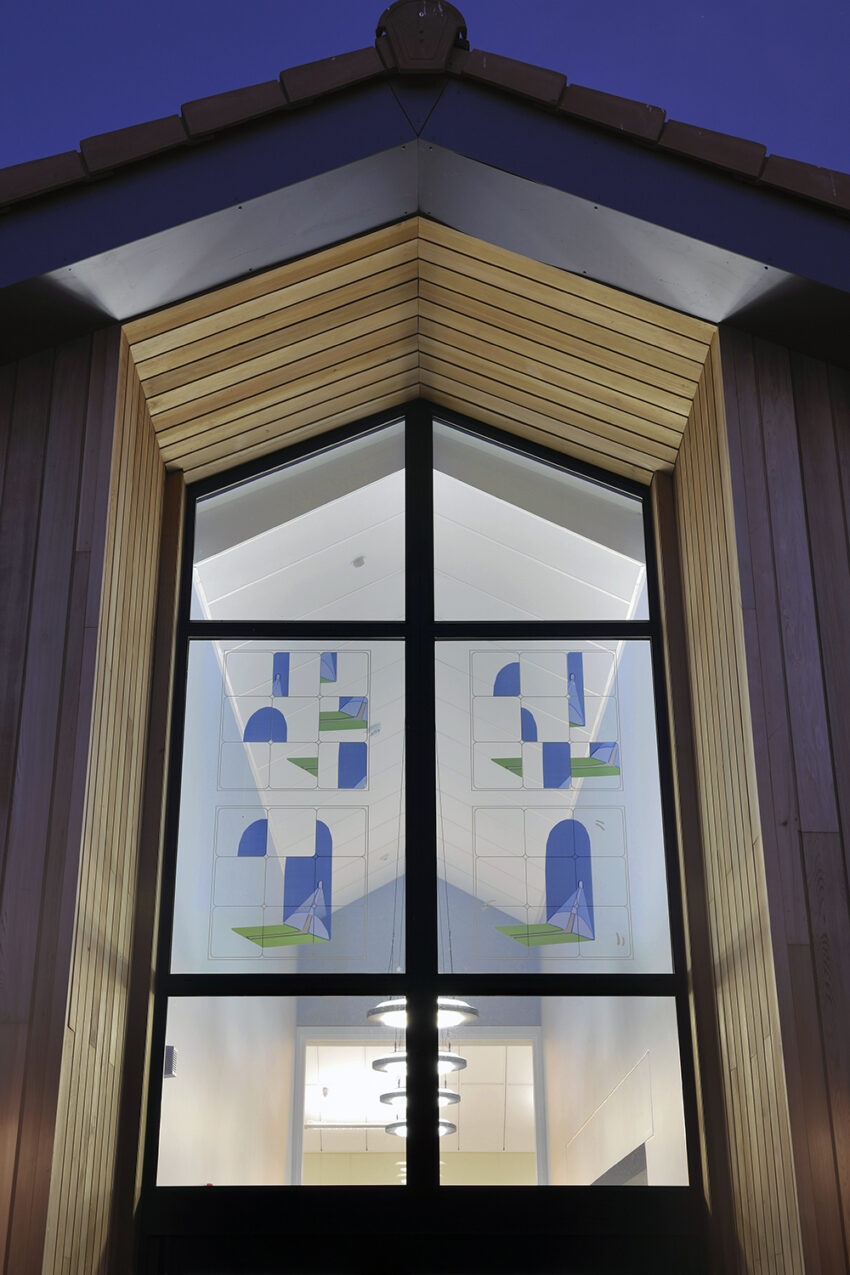

How do we perceive the architecture that surrounds us? How might we (as an architect or an artist might), represent the built environment on a flat two-dimensional surface? What simple and effective illusions can we employ in order to give shapes volume, depth and perspective?

By employing the above themes and the mechanics of a simple ‘sliding puzzle’ and referencing Wile E. Coyote’s confusion at the painted tunnel, Tom has attempted to answer these questions by a glass artwork puzzle that perhaps asks questions itself. In education, aren’t the right questions more important than the right answers…?
