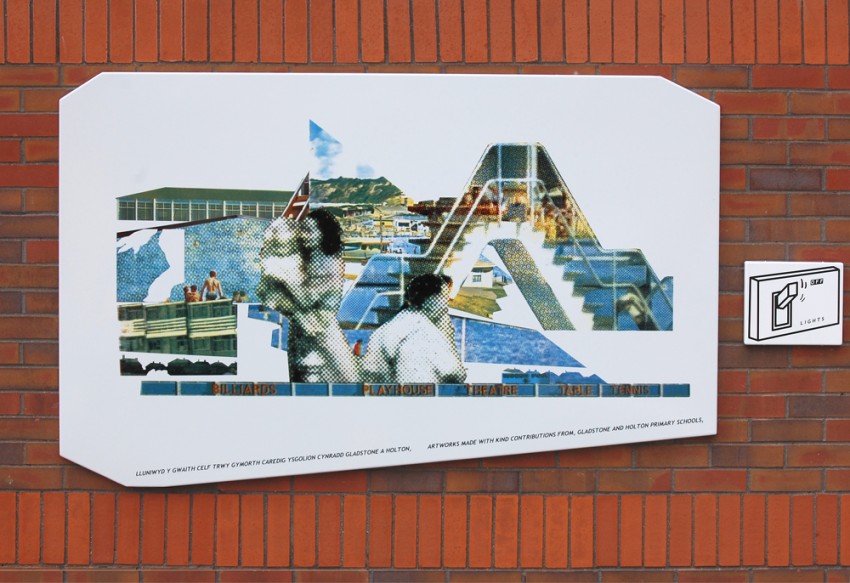
Tom Pearman was commissioned by Vale of Glamorgan Council to create a series of large-scale public artworks for Barry town centre, drawing on the town’s history of cinema, theatre and popular entertainment.
The project takes particular inspiration from Leon Vint’s Electric Palace, an early cinema that once stood on Thompson Street, alongside Barry’s wider history of theatres and venues where moving images and early forms of cinema could be experienced from the late nineteenth century onwards.
Cinema Switches
A series of enlarged switches and controls became a recurring visual device within the artworks.
Rendered at architectural scale in vitreous enamel, familiar instructions such as ON PROJECTOR and OFF LIGHTSrefer directly to the practical machinery of cinema — the moment when the lights go down and the projector begins.
The switches transform small, normally overlooked functional objects into bold public images, connecting the physical operation of a cinema with the anticipation and spectacle of watching a film.
Their simplified black-and-white graphic treatment also recalls technical diagrams, instruction labels and the visual language of early electrical equipment.
Cinema and print
The wider artwork draws on a range of visual languages associated with the history of cinema, photography and printing.
Historic imagery of Barry, its entertainment venues and audiences is combined through collage, while halftone patterns and reproduced photographic textures reference the processes through which images were historically printed and circulated.
By bringing these different visual techniques together, the project presents Barry’s cinema heritage as something layered and fragmented rather than as a conventional historical illustration.
Barry’s entertainment history
At the turn of the twentieth century, Barry had a lively culture of theatres, halls and early cinemas.
The Electric Palace provides a particular point of reference, but the artwork looks more broadly at the role of public entertainment within the town and the shared experience of gathering to watch performances and moving images.
The imagery connects this history with contemporary Barry, celebrating entertainment as part of the town’s social and cultural identity.
Public artwork
The completed works were fabricated in vitreous enamel, allowing photographic, graphic and typographic imagery to be reproduced as durable permanent artworks within the public realm.
The different panels combine historic imagery with the simplified cinema-switch graphics, establishing a visual relationship between the people and places associated with Barry’s entertainment history and the equipment that made the experience of cinema possible.
Project archive
A dedicated project website documents the commission and its development in greater detail: